
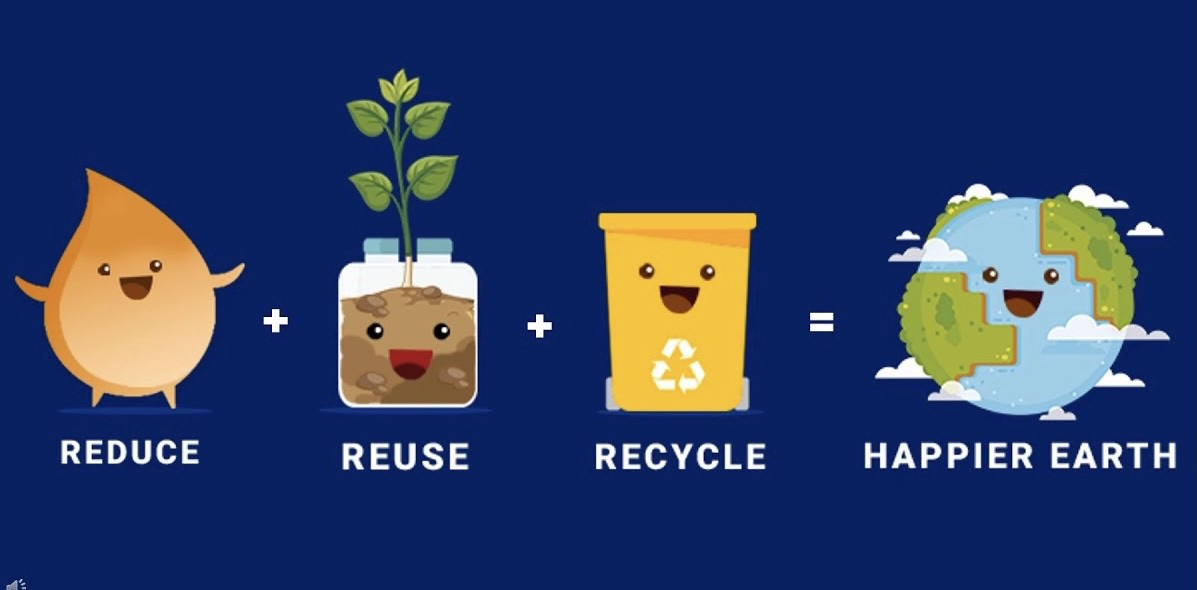
Most people think of ‘recycling’ when they think of waste reduction; in reality, ‘reduce’ and ‘reuse’ are almost always better solutions to too much waste.
But the idea of recycling caught on big time in the 1980’s and since then it has been ‘recycle, recycle, recycle’ instead of reduce, reuse, recycle.
So what do we mean by that? What do we mean by reduce? What is reuse? And how do they differ from and/or are better than recycling?
First (#1) REDUCE.
Reduce means minimizing the amount of material and energy that goes into making the new thing you’re buying.
For example, buying a smaller car, purchasing a washable dish cloth instead of paper towels, carrying and refilling a water bottle instead of purchasing and discarding bottled water, etc.
If you don’t make or buy something in the first place, then you don’t need to worry about reduce, or recycle… you’ve already saved all the materials and energy that would go into making it, using it, and disposing of it.
Then (#2) REUSE.
Reuse extends the life of items that you or someone else has already purchased.
Examples of reuse are common… such as donating items you can no longer use to someone else who can and will continue to use them.
Repairing a computer, rather than trashing it would be another example.
Deconstructing a building, salvaging the lumber and hardware, and reusing or repurposing it in other buildings is a third.
Designing something to be durable, repairable is probably a preferred way for us to ‘boost reuse’.
Finally (#3) RECYCLE.
Recycling is meant to deal with something when it is absolutely at the end of its life… and the only other option is wasting it.
Recycling breaks down the item or material into its component parts, and then sends it off to a manufacture to make more of the same from scratch, or as a raw material for something else.
For example, a car that goes to the wrecking yard may have some parts removed and resold (for reuse) but what’s left of the car after that will be chopped up, melted down, and the steel, fabric, oil and other materials in it sold to make new stuff.
The glass containers that hold your olives, or pickles will likely be smashed into smithereens, and may then be sold as soil amendments (like perlite or vermiculite), or may be mixed into paint to create center yellow lines that glow at night, or…it might be sold back to bottle manufacturers who sort it by color, and then recycle it back into new glass jars and bottles.
In that order.
So the ‘waste hierarchy’ places reduce ahead of reuse, and reuse ahead of recycling, for very good reasons.
When looking at the life cycle of ‘stuff’ and doing an analysis of energy used for our stuff (and waste generated as a result) scientists and engineers can show that the CO2 emissions from ‘reduce’ are almost always lower than for ‘reuse’. These emissions are similarly much lower for ‘reduce’ than for ‘recycle’. And usually anyone of these trumps ‘landfill’ or ‘waste to energy’ etc.
So that’s it for my 1st blog… Thanks for listening, in the next Norm’s Notes, I’ll go into some of the pluses and minuses of reduce, reuse, and recycle (in that order) and why it’s most important for us to boost reduce and reuse, while keeping recycling for items and materials that are at end of their useful lives as presently constituted.
Until next time,
Norm